Sensory Calming Kits for Children’s Big Feelings
A wobble before school, tears at bedtime, or a sudden storm of anger over the wrong-coloured cup can leave both child and parent feeling helpless. Sensory calming kits offer a gentle, practical way to meet those moments with comfort rather than pressure. They give a child something safe and familiar to reach for while their body begins to settle and their big feelings become easier to hold.
A calming kit is not a promise that every difficult moment will disappear. It is a small, thoughtful collection of tools that can help a child pause, feel supported and gradually return to their own inner calm. Used consistently, it can become a reassuring part of family life – at home, before sleep, in the car, or when a busy day has simply become too much.
What are sensory calming kits?
Sensory calming kits are personalised boxes, bags or baskets containing items that support regulation through the senses. Some children settle through touch, such as squeezing a soft fidget or holding a weighted lap pad. Others respond best to a familiar scent, a quiet sound, a gentle visual focus or a comforting story.
The aim is not to distract a child away from their emotions or persuade them that their feelings are wrong. It is to help their nervous system feel safer while they move through those emotions. Once the intensity has eased, there is more room to talk, listen and work out what is needed.
For parents, this can be a helpful shift. Rather than searching for the perfect words in the middle of a meltdown, you can offer a simple choice: “Would you like your calming kit?” Over time, children may learn to recognise their own early signs of overwhelm and use the kit before feelings grow too large.
Why sensory support can help with big feelings
Children do not always have the language to explain that the classroom felt too noisy, that they are worrying about a test, or that separation at bedtime feels hard. Their bodies often speak first. They may become clingy, restless, cross, tearful or unusually quiet.
Gentle sensory input can create a bridge between overwhelm and regulation. A slow breathing exercise with a pinwheel gives the breath a purpose. Stroking a soft piece of fabric offers a steady sensation when thoughts are racing. Listening to a familiar, soothing voice can help make an uncertain moment feel more predictable.
What helps varies from child to child. A child who finds a lavender pouch comforting may dislike the smell altogether on another day. A fidget toy can support concentration for one child but become another source of stimulation for someone else. The most effective kits are never one-size-fits-all. They are built with curiosity, kindness and a willingness to notice what genuinely helps.
What to include in a calming kit
Start small. A kit does not need to be expensive, beautifully arranged or packed with every possible sensory item. Too many choices can feel overwhelming in itself. Choose a few items your child can use safely and independently, then adapt the kit as you learn more about their needs.
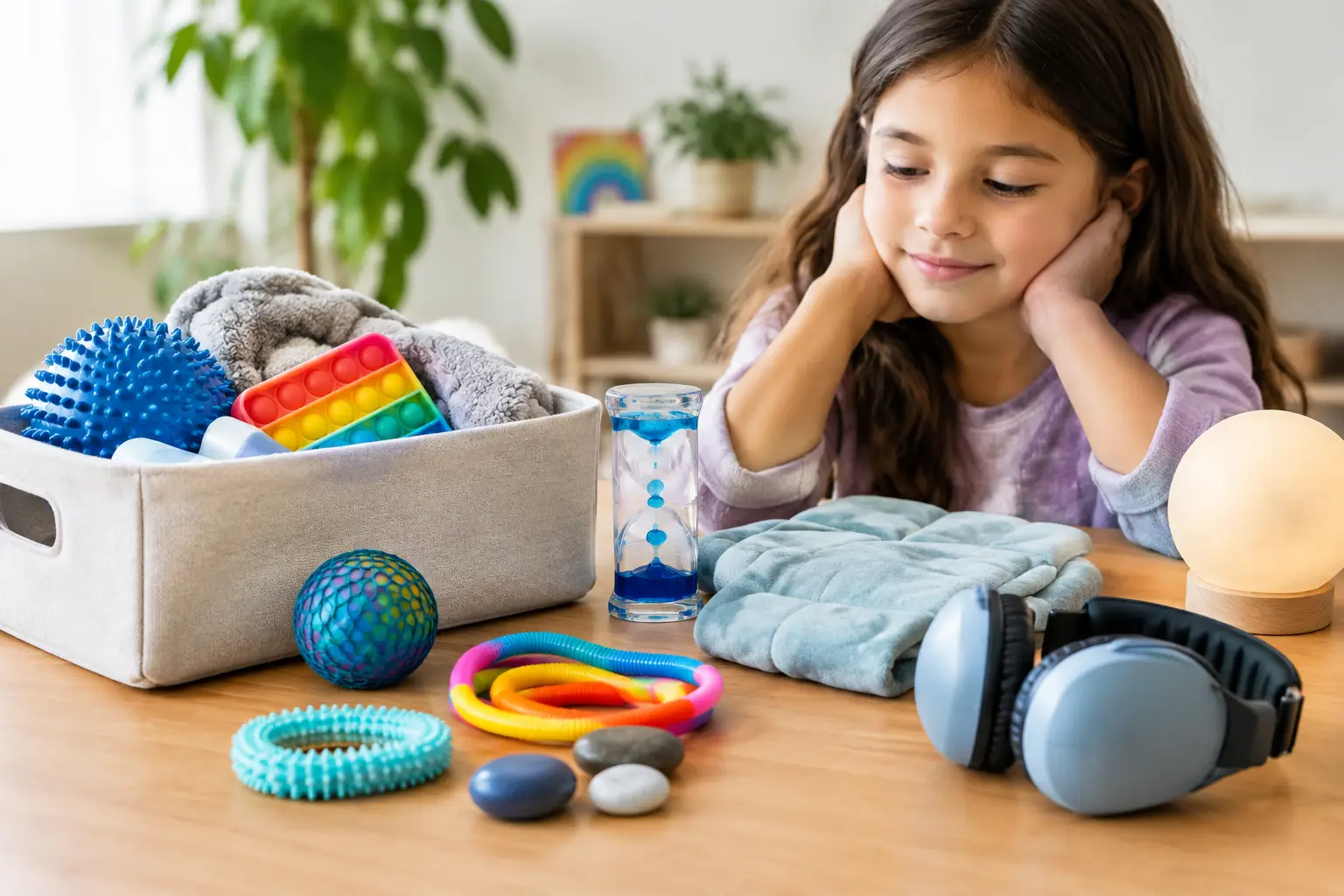
A balanced sensory calming kit may include:
- A soft tactile item, such as a smooth worry stone, small plush toy, fabric square or quiet fidget.
- A breathing prompt, perhaps a pinwheel, bubbles for supervised use, or a card showing a simple slow-breathing pattern.
- A visual comfort item, such as a small glitter timer, calming picture card or favourite family photograph.
- A listening option, including gentle music, nature sounds or a familiar therapeutic audio.
- A comforting story that names worries, encourages safety and helps a child imagine a calmer outcome.
For younger children, a small comfort toy and a simple picture book may be enough. Older children may prefer a discreet pocket-sized kit with headphones, a tactile keyring, a notebook and a short grounding prompt. The best kit is one that feels age-appropriate rather than babyish, particularly for children approaching their teenage years.
Be mindful of safety. Avoid small parts for children who may mouth objects, check that items are sturdy, and supervise scented products, putty or anything that could cause a reaction. If your child is sensitive to noise, bright light or particular textures, respect that information. Their “no” is useful guidance.
Build the kit around the moments that feel hardest
A calming kit becomes more useful when it has a clear purpose. Think about when your child most often needs extra support. Is it the rush of getting dressed in the morning? The transition from school to home? Homework frustrations? The quiet before sleep, when worries can suddenly seem very loud?
For bedtime worries, keep the kit near the bed and make it part of a predictable wind-down. A soft sensory item, a warm drink where appropriate, a therapeutic story and calming audio can signal that the day is gently ending. The repetition matters. Children often find comfort not only in the item itself, but in knowing what comes next.
For school-related anxiety, a smaller kit may work better. A discreet tactile object in a coat pocket, a reassuring phrase written on a card, or a short audio listened to before leaving the house can provide a sense of continuity. If the school is supportive, it may be helpful to agree on one item your child can access when they need a quiet moment.
After an emotional outburst, use the kit first and the conversation later. A child in the grip of overwhelming feelings is not being difficult on purpose, and they may not be ready to explain themselves. Sit nearby, speak softly and offer one or two choices. When calm returns, you can gently untangle what happened together.
Make calm a practice, not a punishment
One of the most helpful ways to introduce a kit is to use it when your child is already settled. Explore the items together on a calm afternoon. Let them choose a name for the box, decorate it, or decide which object belongs where. This builds ownership and means the kit does not become associated only with being told off or feeling out of control.
You might say, “Everyone has times when their feelings feel too big. These are some things we can use to help your body feel safe and comfortable.” That language keeps the focus on support rather than fixing.
Try not to insist that your child use a particular tool because it worked yesterday. Offer without pressure. Sometimes they may want a hug, a drink of water or simply quiet company instead. The kit is an invitation, not a test.
Pair sensory comfort with therapeutic stories and audio
Sensory objects can settle the body in the moment, while stories and audio can offer a deeper sense of reassurance. A carefully chosen story gives children words and images for experiences that can otherwise feel confusing. It can show them that worries are manageable, that disappointment does not define them, and that they have a safe place within themselves to return to.
Guided calming audio can be especially valuable as part of an evening routine or before a challenging event. A gentle voice, slow pace and soothing imagery can help children release the day’s tension without asking them to find the right words. Peter Bates Holistic Books brings these two forms of support together, pairing therapeutic storytelling with companion audio designed to encourage rest, confidence and emotional ease.
There is no need to make this a lengthy routine. Five or ten quiet minutes, repeated often, can become a meaningful anchor. The goal is not perfect stillness. It is helping your child build a familiar pathway back towards feeling safe.
When a kit is not enough on its own
Sensory tools are supportive, but they are not a replacement for professional care when a child’s distress is persistent, severe or affecting daily life. Speak to your GP, school pastoral team or an appropriately qualified mental health professional if anxiety is stopping your child from sleeping, attending school, eating, enjoying relationships or taking part in ordinary activities.
Extra support is also important if your child talks about hurting themselves or seems unsafe. Trust your instincts. Asking for help is a caring response, not a failure.
A small box of thoughtfully chosen comforts cannot solve every worry. Yet when it is offered with patience, warmth and a steady adult nearby, it can tell a child something deeply important: your feelings make sense, you are not alone, and calm can be found again.