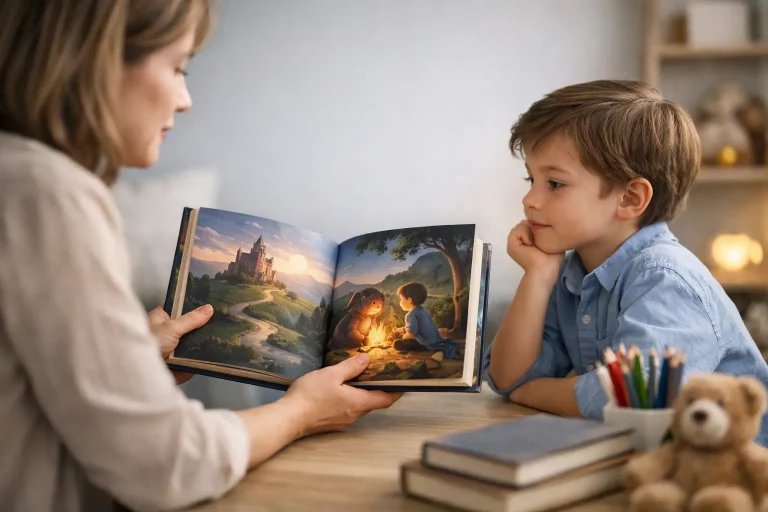

Child Anxiety Books That Bring Calm at Home
A child who worries may not say, “I feel anxious.” They may complain of a tummy ache before school, become tearful at bedtime, repeatedly ask what is happening next, or seem cross over something very small. For many families, child anxiety books offer a gentle first way to name those feelings without putting a child on the spot.
The right story can make a worry feel less lonely. It gives children a character to recognise, words for the big feelings in their body, and a calm pathway back towards safety. Read at the right moment, and returned to often, it can become a familiar part of home life: a small pause where worries are allowed, understood and softened.
Why stories can help an anxious child
Children do not always process worry through direct questions. Asking, “What are you anxious about?” can be useful, but it can also feel too big when a child does not have the language, does not know the answer, or fears getting something wrong. A story creates a little emotional distance. The worry belongs to a character first, which can make it safer to talk about.
A child may say, “That is like me,” or “I do that too,” while looking at the page rather than directly at an adult. That moment matters. They are beginning to connect an inner experience with words, and to see that feelings can change.
Stories can also make calming strategies feel natural rather than like a task. Slow breathing, imagining a safe place, noticing friendly thoughts, or preparing for a difficult situation can be woven into the character’s journey. Instead of being told to calm down, a child sees what calm can look and feel like.
Of course, a book is not a switch that removes every worry. Anxiety can be protective, and children need time, reassurance and practice to build confidence. But a well-chosen book gives parents and carers a repeatable tool for those moments when the worry is loud and everyone is tired.
What to look for in child anxiety books
Not every book about emotions will suit every child. Some children need a playful, illustrated story; others, especially older children, may prefer a more realistic situation involving school, friendships, tests or sleep. The best choice depends on the child’s age, their particular worries and how they usually respond to stories.
Look for a book that treats feelings with kindness. Anxiety should not be presented as naughty behaviour, a weakness or something a child simply needs to “get over”. Helpful stories acknowledge that a racing heart, a busy mind or a need for reassurance can feel very real. They offer comfort without promising that life will always be free from difficult moments.
It also helps when the story has a clear emotional arc. The character notices a problem, receives support or learns a gentle skill, and finds a way through the moment. The ending does not need to be perfect. In fact, an ending that shows courage alongside lingering nerves can feel more believable and reassuring.
For children with bedtime worries, choose calmer language and a soothing pace. A book that introduces frightening scenarios in too much detail may be better read during the day, if at all. For school or exam stress, a story that focuses on preparation, self-belief and coping with uncertainty can be more useful than one centred only on fear.
Choose a book that feels emotionally safe
Before reading a new book together, take a few minutes to read it yourself. Notice whether the wording feels supportive, whether the illustrations might overwhelm a sensitive child, and whether the suggested coping ideas fit your family’s values.
A useful book should leave room for a child’s own experience. They may not relate to every detail, and that is fine. You are not trying to persuade them that their worry is identical to a character’s. You are offering the message that worries happen, help is available, and they do not have to handle big feelings alone.
Making a book part of a calming routine
The power of a child anxiety book often comes from repetition. Reading it once can open a conversation. Reading it regularly can give the child familiar words and cues to use when worry appears in real life.
Bedtime is a natural time for many families, particularly when worries grow louder after a busy day. Keep the routine gentle: dimmer lights, a comfortable place to sit, and no pressure to discuss every page. Read slowly. If the child wants to pause at a picture, repeat a line or hold a favourite soft toy, let that be part of the experience.
You might ask one simple question afterwards: “What helped the character feel a little safer?” If your child is willing, follow with, “Would anything like that help you?” Some evenings they will talk. Other evenings they may simply listen, and that still has value.
For daytime anxiety, read when things are calm rather than only in the middle of a meltdown. A child who is already overwhelmed may need connection first: a cuddle, a drink of water, quiet company, or a few slow breaths together. The story can then become a bridge back to a more settled state.
At Peter Bates Holistic Books, therapeutic storytelling is paired with companion calming audio so children can hear supportive messages in another soothing format. This can be particularly helpful for children who settle more easily by listening, or for families who would like a gentle extension to the bedtime routine.
Turning the story into everyday support
The most helpful books do not stay closed on the shelf after reading. Bring their language into ordinary moments, lightly and without overdoing it. If a character practises “balloon breaths”, you might say, “Shall we try one of the character’s balloon breaths before we leave?” If they have a safe-place image, remind your child they can picture it while waiting for the dentist or settling into bed.
This works best when it feels shared, not corrective. Rather than saying, “You need to use your book strategy,” try, “Your worry seems quite busy today. Shall we remember what helped in that story?” The difference is small, but the second approach protects a child’s dignity and invites cooperation.
It can also help to create a predictable phrase that the whole family uses, such as, “We can make space for this feeling.” Children learn that feelings are visitors, not permanent definitions of who they are. They can feel frightened and still be brave. They can need support and still be capable.
When a book is not enough on its own
Home-based tools can be deeply comforting, but they are not meant to carry the whole weight of severe or persistent anxiety. If worry is stopping your child from sleeping, attending school, eating, seeing friends or enjoying everyday life, seek further support. A GP, school pastoral lead, health visitor, school nurse or qualified child mental health professional can help you understand what is happening and what support may be appropriate.
Seek prompt professional advice too if your child speaks about harming themselves, seems hopeless, is experiencing panic attacks, or their behaviour changes suddenly and significantly. Asking for help is not a failure of the routines you have tried. It is a caring response to a child who needs more support around them.
For many children, though, a gentle story remains a meaningful place to begin. It says: your feelings make sense, you are safe with me, and we can meet this worry one small, calm step at a time.