Mindful Breathing for Children with Big Worries
A child may be perfectly happy one moment, then suddenly tearful, cross or unable to settle the next. When big feelings arrive, reasoning rarely helps straight away. Their body needs to feel safe before their mind can untangle the worries. Mindful breathing for children is one small, gentle way to create that pause.
It does not require a silent room, a perfect routine or a child who is naturally calm. A few unhurried breaths can offer something much more realistic: a familiar signal that says, “You are safe. We can slow down together.” Over time, this simple practice can become a reassuring tool for bedtime worries, school stress, frustration and those moments when emotions feel too large to manage.
Why breathing helps when feelings feel big
When a child is anxious, upset or overwhelmed, their nervous system can move into a state of alarm. Their heart may beat faster, their tummy may feel funny and their thoughts can race ahead to everything that might go wrong. Telling them to “calm down” can feel impossible when their body is still expecting danger.
A slower, softer out-breath can help the body begin to shift out of that alarm state. It is not a magic switch, and children will still have difficult moments. Yet breathing gives them something concrete to do when they do not have the words for what is happening inside.
The value is not in making a child suppress sadness, anger or fear. It is in helping them make enough space around the feeling that it becomes less frightening. Once their body has settled a little, they may be more able to talk, accept comfort or think of what they need next.
Mindful breathing for children should feel like play
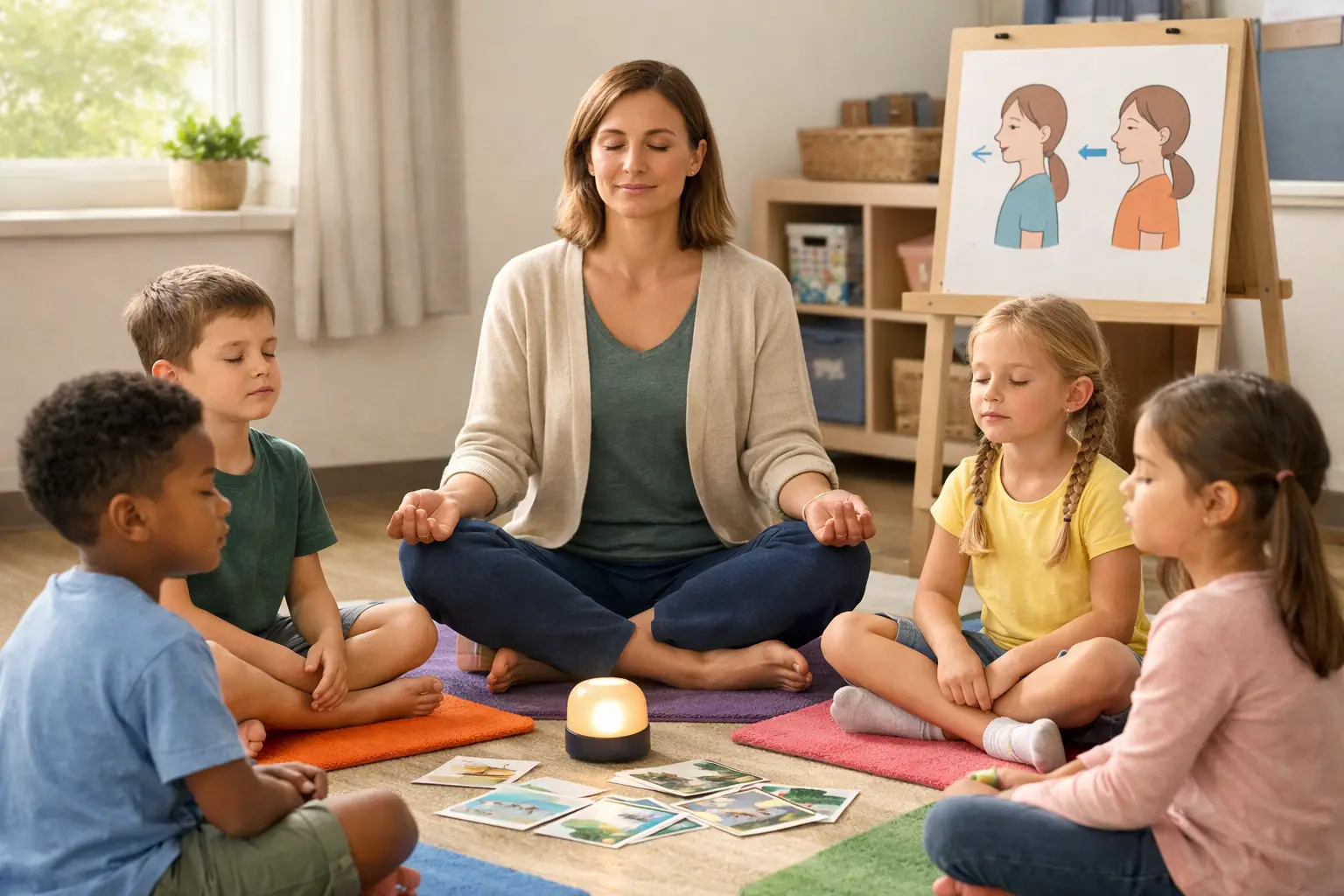
Adults sometimes picture mindfulness as sitting still with closed eyes. For many children, particularly younger ones, that can feel strange or demanding. A more helpful approach is to make breathing imaginative, brief and choice-led.
Try inviting rather than instructing. “Shall we help our shoulders soften with one balloon breath?” is likely to feel kinder than “Take a deep breath.” Some children dislike big breaths or feel light-headed when asked to breathe deeply. Slow, comfortable breathing is enough. There is no need to force it.
The most useful practices often have a picture attached to them. A child can understand how to smell a flower and gently blow a dandelion seed, or how to make hot chocolate cool without splashing it. These images give their attention somewhere safe to rest.
The flower and candle breath
Ask your child to imagine holding a favourite flower close to their nose. They breathe in gently, as though noticing its scent. Then they imagine a candle in front of them and breathe out slowly enough to make its flame dance, but not go out.
Repeat this two or three times. Keep your voice low and unhurried. The aim is not to get the breathing exactly right. It is simply to share a quiet moment of noticing.
The hand-tracing breath
This can work especially well in the car, after school or while waiting for sleep to arrive. Hold up one hand with fingers spread. With the index finger of the other hand, trace slowly up one finger while breathing in, then trace down while breathing out. Continue around the hand.
The movement can make the exercise easier for children who find it hard to sit still. It also gives them a discreet technique they may be able to use independently at school.
The teddy-on-the-tummy breath
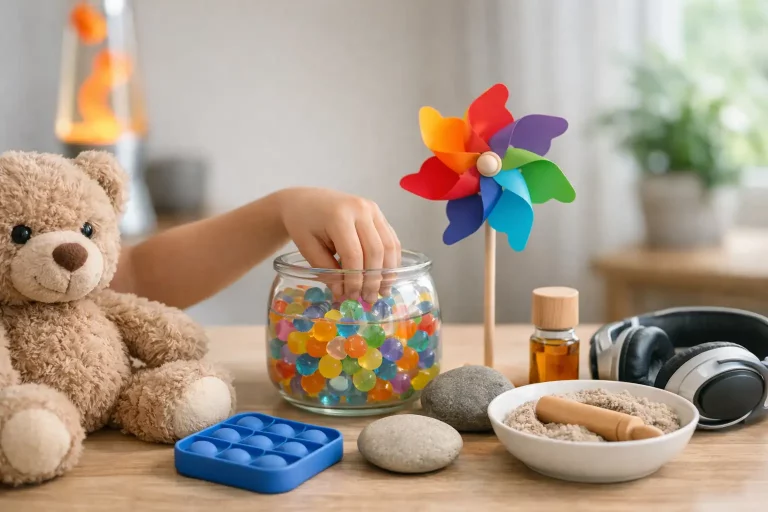
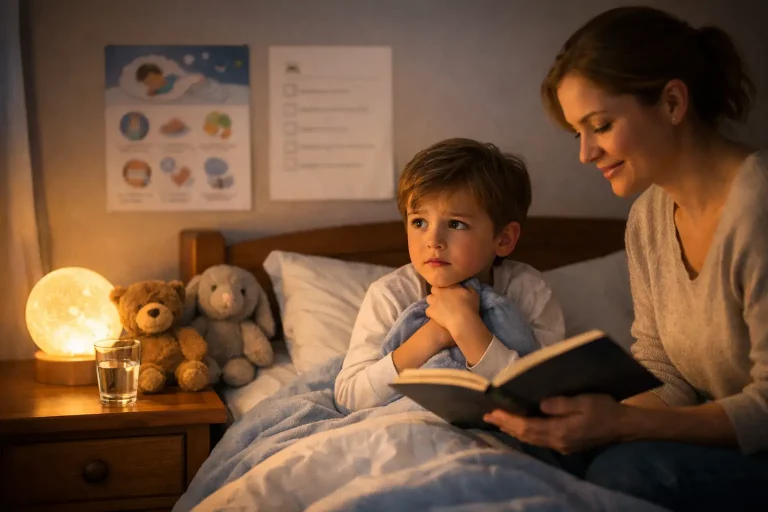
At bedtime, a small soft toy can become a calming companion. Let your child lie comfortably with a teddy resting on their tummy. Invite them to watch it rise a little as they breathe in and fall as they breathe out.
There is no need to count or correct them. A gentle story such as “Teddy is floating on a sleepy sea” can make the experience feel cosy rather than like another task before bed.
When to use a breathing practice
Mindful breathing is often most effective when it is practised before a child reaches breaking point. A few breaths after getting into bed, before a spelling test or on the way home from a busy day help build familiarity. Then, when worries do rise, the practice does not feel new or forced.
Bedtime is a particularly natural time to begin. The house is quieter, distractions have faded and worries that were kept busy during the day can surface. Rather than trying to solve every concern at the side of the bed, offer connection first. You might say, “Those thoughts seem very busy tonight. Let’s give your body a few soft breaths, then we can decide whether your worry needs talking about.”
After school can be another useful window. Some children hold themselves together all day and release everything when they get home. A snack, a drink and two minutes of breathing or listening to a soothing guided audio can help them transition before questions about their day begin.
Your calm matters too
Children often take their cue from the adults around them. If you are speaking quickly, checking the clock or trying hard to make the exercise work, they may feel that pressure. You do not have to be perfectly calm yourself. Simply breathing alongside them can be powerful.
Try allowing your own shoulders to drop and lengthening your out-breath naturally. Use fewer words. A hand held, a back gently stroked or your steady presence may be more reassuring than a detailed explanation.
This is one reason a familiar story or therapeutic audio can be helpful in a family routine. It gives both parent and child a peaceful structure to return to, without either of you needing to find the right words in a difficult moment. At Peter Bates Holistic Books, stories and calming audio are created to support that gentle rhythm of reassurance, imagination and rest.
What if your child will not join in?
It is completely normal for children to refuse a calming exercise, especially when they are already cross or distressed. Pushing can turn a supportive tool into a power struggle. Instead, let them know it is available and model it for yourself.
You might say, “I am going to do three flower breaths because my body feels a bit buzzy.” Often, curiosity follows when there is no expectation. If it does not, that is all right. A child may prefer drawing, walking, squeezing a cushion, listening to music or sitting quietly beside you. Mindful breathing is one option, not a test they can fail.
It also depends on the child’s age and temperament. A three-year-old may respond best to a game with bubbles or a teddy, while an older child may appreciate knowing that a slower out-breath can help their body settle before an exam or a difficult conversation. Teenagers may prefer privacy and a short guided relaxation they can listen to in their own room.
Keep it small and repeatable
The most helpful routine is usually the one that fits into real family life. Start with one minute rather than aiming for ten. Choose a predictable moment, such as after teeth are brushed or before getting out of the car at school. Repetition helps the body recognise, “This is our calm-down time.”
Praise the effort, not the outcome. Instead of asking whether they feel better, you could say, “You gave your body a quiet moment.” This keeps the practice free from pressure and reminds them that they can care for themselves even when the worry has not disappeared.
Mindful breathing can sit alongside other forms of support. If your child’s anxiety is persistent, affects school, sleep or everyday life, or leaves them feeling unsafe, speak with their GP, school pastoral team or an appropriately qualified professional. Gentle home tools are valuable, but families do not have to carry serious worries alone.
A calm breath will not remove every hard feeling. What it can offer is a small place to begin: a moment of safety, a little more room inside the body, and the quiet reminder that big feelings can be met with kindness.