
Why Storytelling Is Important to a Child
A child curled up beside you, listening closely as a story unfolds, may look as though they are simply being entertained. Yet this quiet moment is often doing far more than filling time before bed. If you have ever wondered why storytelling is important to a child, the answer begins here – stories help children make sense of feelings, feel safer in their world, and practise calm in a way that feels natural rather than forced.
For many parents, the real value of storytelling becomes clearest when a child is anxious, overtired, frustrated or struggling to put big feelings into words. Advice can feel too direct. Questions can feel too much. A story, though, gives a child a gentle place to meet an emotion without feeling exposed. They can recognise themselves in a character, notice a fear, a worry or a triumph, and begin to understand their own inner experience with less pressure.
Why storytelling is important to a child emotionally
Children do not always have the language to say, I feel overwhelmed, I am frightened of failing, or I cannot settle because my mind will not switch off. What they often do have is imagination. Storytelling meets them there.
When a child hears about a character who is nervous on the first day of school, worried about the dark, or upset after making a mistake, they are offered emotional reflection without judgement. The story gives shape to something that may have felt confusing inside. This matters because children cope better when they can recognise what they are feeling and sense that those feelings can be managed.
Stories also create emotional distance, and that distance can be very comforting. A child may resist talking about their own fears but feel perfectly able to talk about a bear who cannot sleep or a girl who feels a knot in her tummy before a test. Through that safer conversation, they begin to untangle the worries indirectly. Often, that is exactly what makes it work.
There is a practical point here too. Not every story soothes every child. Some children love adventure and reassurance wrapped together. Others need gentler pacing, softer language and a predictable ending. It depends on the child, the moment and what they are carrying emotionally.
Stories help children feel safe enough to settle
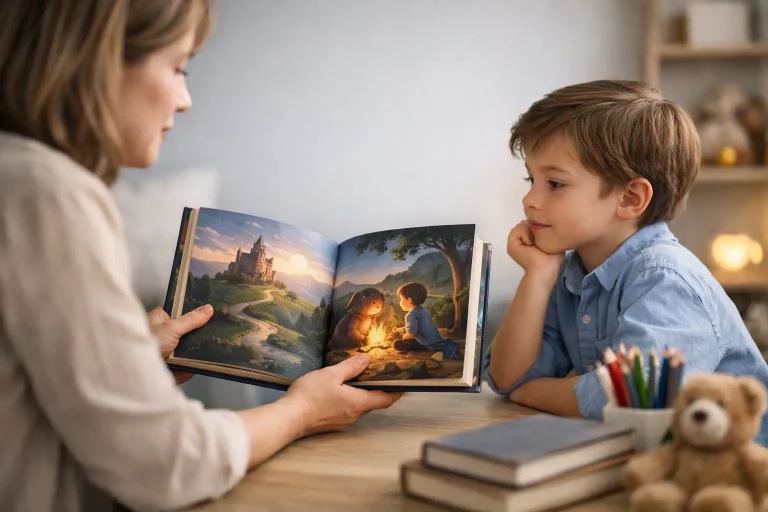
One reason storytelling is so powerful at bedtime is that it helps the nervous system slow down. A calm voice, repeated rhythms and a familiar structure can signal safety. For a child who has had a busy, overstimulating day, this matters enormously.
When children feel emotionally stirred up, they do not always need more explanation. They often need help shifting state. A soothing story can guide attention away from the day’s tension and into a calmer inner space. Instead of battling with sleep or becoming trapped in bedtime worries, the child is offered a bridge from alertness to rest.
This is part of why therapeutic storytelling can be especially helpful. A well-crafted story does not simply distract. It can gently introduce breathing, safety, confidence or release in a form a child can absorb without resistance. At Peter Bates Holistic Books, this is understood as more than reading for pleasure. It becomes an emotional support tool that families can return to again and again.
Why storytelling is important to a child’s development
Parents are often told that stories help with language, and they do. Children hear new words, different sentence patterns and richer ways of expressing thoughts. They learn how conversations flow, how events connect and how meaning builds over time.
But storytelling supports development more deeply than vocabulary alone. It helps children understand sequence, cause and effect, and perspective. They begin to grasp that choices have consequences, that people think differently, and that problems can have more than one solution. These are building blocks not only for learning at school but for managing relationships and everyday challenges.
There is also memory and attention. Following a story asks a child to listen, imagine and hold information in mind. For some children this comes easily. For others, especially those who are worried or dysregulated, it can take practice. A story offers that practice in a gentle and rewarding way.
Importantly, storytelling does not need to be polished to be effective. You do not have to perform perfectly, invent elaborate voices or remember every detail. What a child responds to most is connection. Your calm presence, your tone, and the ritual of shared attention often matter more than a flawless reading.
Stories build confidence from the inside out
Confidence in children is not only about praise or achievement. Often, it grows when they begin to feel capable inside themselves. Stories can support this by showing children that fear, doubt and setbacks are part of being human, not proof that something is wrong with them.
A child who hears stories about persistence, courage and emotional recovery starts to build an inner map. They learn that difficult moments can move, soften and change. They see that characters wobble, regroup and try again. Over time, this can strengthen a child’s own self-belief.
This is especially useful for children facing exam nerves, friendship worries, separation anxiety or sensitivity around new situations. They may not need grand speeches about resilience. They may need repeated, gentle experiences of hearing that challenges can be faced and that calm can return.
That said, stories should not be used to dismiss a child’s real distress. If a child is deeply anxious, storytelling works best alongside attuned support, routine and, where needed, professional guidance. The story opens the door, but the relationship around it is what helps the child walk through.
The special role of repetition
Adults sometimes worry that reading the same story again and again is dull or unnecessary. For children, repetition is often where the deepest benefit sits. Familiar stories reduce uncertainty. They allow a child to relax because they know what is coming. That predictability can be deeply regulating.
Repetition also helps children absorb emotional messages more fully. On the first reading, they may simply follow the plot. By the fifth or tenth, they begin to notice how the character copes, what brings comfort, and how the difficult feeling shifts. In therapeutic stories, this repeated exposure can gently reinforce a calmer pattern of thinking and feeling.
If your child asks for the same story every night during a stressful patch, there is usually a reason. They may be using that story as an anchor. Rather than seeing it as a habit to break, it is often wiser to notice the comfort it is providing.
Why storytelling is important to a child in everyday family life
Storytelling does not only belong at bedtime. It can support transitions throughout the day – before school, after a difficult afternoon, or during moments when emotions are running high. A short story can help a child reset, reconnect and feel understood.
It also offers something many families are short of: calm shared attention. In busy households, children can pick up on tension quickly. Story time creates a pause. It tells a child, even briefly, you are safe, you are with me, and we can breathe here. That sense of connection is not a small thing. It helps children regulate because they feel held, not hurried.
For older children, storytelling may look different. It might be a chapter book, an audio story, or a reflective narrative that speaks to worries about school, identity or pressure. The format can change with age, but the need remains similar. Children and young people still benefit from stories that help them process emotions and imagine a steadier way through.
Parents sometimes wonder whether stories can really make a difference when a child is struggling. The honest answer is that a story is not magic on its own. But in the right form, at the right moment, repeated with care, it can become one of the gentlest and most effective ways to help a child feel calmer, understood and more able to cope.
Sometimes the greatest gift of a story is that it asks very little of a child. They do not have to explain everything. They do not have to solve everything. They only have to listen, imagine and let the words do some of the holding. And for a child carrying big feelings, that can be the beginning of real relief.